

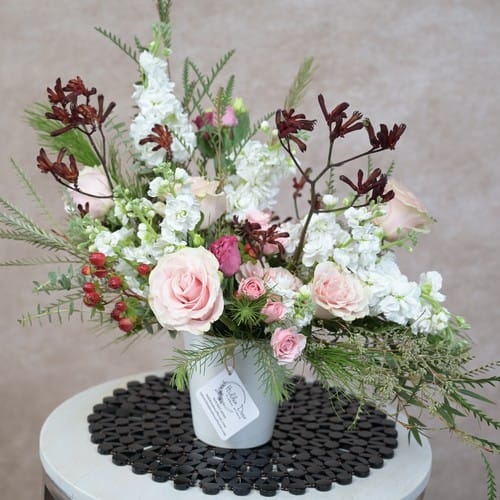
Great floral arrangement design is not about stuffing as many flowers as possible into a vase. People sometimes ask us what makes one flower arrangement look so much better than another. It’s a fair question. You can put the same flowers in two different vases and get two completely different results: one that looks like it belongs in a magazine, and one that looks like it’s trying too hard.
The difference isn’t magic. It’s a handful of design principles that professional florists use instinctively and that anyone can learn to appreciate. Here’s what we think about every time we build an arrangement in our studio.
Floral Arrangement Design: Variety of Shape and Texture
A great arrangement is never just one kind of flower repeated over and over. It’s a conversation between different shapes and textures. We think in terms of three roles:
Focal flowers, The statement makers. Garden roses, peonies, dahlias, large, round blooms that draw the eye and anchor the design.
Supporting flowers, Mid-sized blooms that fill in around the focal flowers and add color depth. Ranunculus, lisianthus, spray roses, and stock fall into this category.
Textural accents, The details that make an arrangement feel finished. Eucalyptus, dusty miller, astilbe, berries, dried elements, and wispy grasses add movement and visual interest that smooth, round blooms alone can’t achieve.
When these three layers work together, the arrangement has depth, your eye moves through it rather than stopping at the surface.
Color Harmony
Color in floral design works the same way it works in painting or fashion: it’s about relationships. A few approaches that consistently look stunning:
Monochromatic, Multiple shades within one color family (blush to dusty rose to deep pink). This creates a sense of sophistication and cohesion.
Analogous, Colors that sit next to each other on the color wheel (peach to coral to warm pink). These palettes feel natural and harmonious.
Complementary, Colors opposite each other on the wheel (purple and gold, for example). Higher contrast and more dramatic, great for making a statement.
The mistake most people make at home is using too many unrelated colors. An arrangement with eight different colors can look chaotic. Three to four colors in a coherent palette almost always looks more intentional.
Proportion and Scale
The arrangement should be proportional to the vessel it’s in and the space it’s going into. A general rule: the arrangement should be about one and a half times the height of the vase. Too short and it looks squat. Too tall and it looks unstable.
For dining tables, keep it low enough that people can see each other across it. For entryways or mantles, you can go taller and more dramatic. And for bedside tables or desks, compact and colorful works best.
Negative Space Matters
This is the one that separates good from great. A crowded arrangement where every flower is crammed in tight can look stuffed rather than designed. Great arrangements have breathing room, a little space between stems where you can see depth and movement. Individual flowers get to be appreciated on their own terms rather than disappearing into a wall of blooms.
Think about how a well-designed room always has some open space. The same principle applies to a vase of flowers.
Asymmetry Is Your Friend
Perfectly symmetrical arrangements look formal and traditional, and there’s absolutely a place for that. But the arrangements that make people stop and look tend to have a touch of asymmetry. One branch reaching slightly higher than the others. A cluster of blooms weighted to one side. A trailing vine that breaks the expected shape.
Controlled asymmetry makes an arrangement feel alive and organic rather than rigid. It’s the difference between a formal portrait and a candid photograph: both beautiful, but one has more personality.
See It in Person
Every arrangement in our collection, from the layered textures of Monet to the clean lines of Elegant White, is designed with these principles in mind. We don’t follow formulas, every piece is built by hand using what’s freshest that day, but these ideas guide how we think about beauty and balance.
If you want to learn more about our design approach or discuss something custom, reach out. We love talking about the details that make flowers feel truly special.
We deliver across Raleigh, Cary, Durham, and the Triangle, see our delivery page for zones and timing.